Google score of 4.8
(28 reviews)
Free delivery in the Benelux and Germany up to 10 kg and from €49 excl. VAT

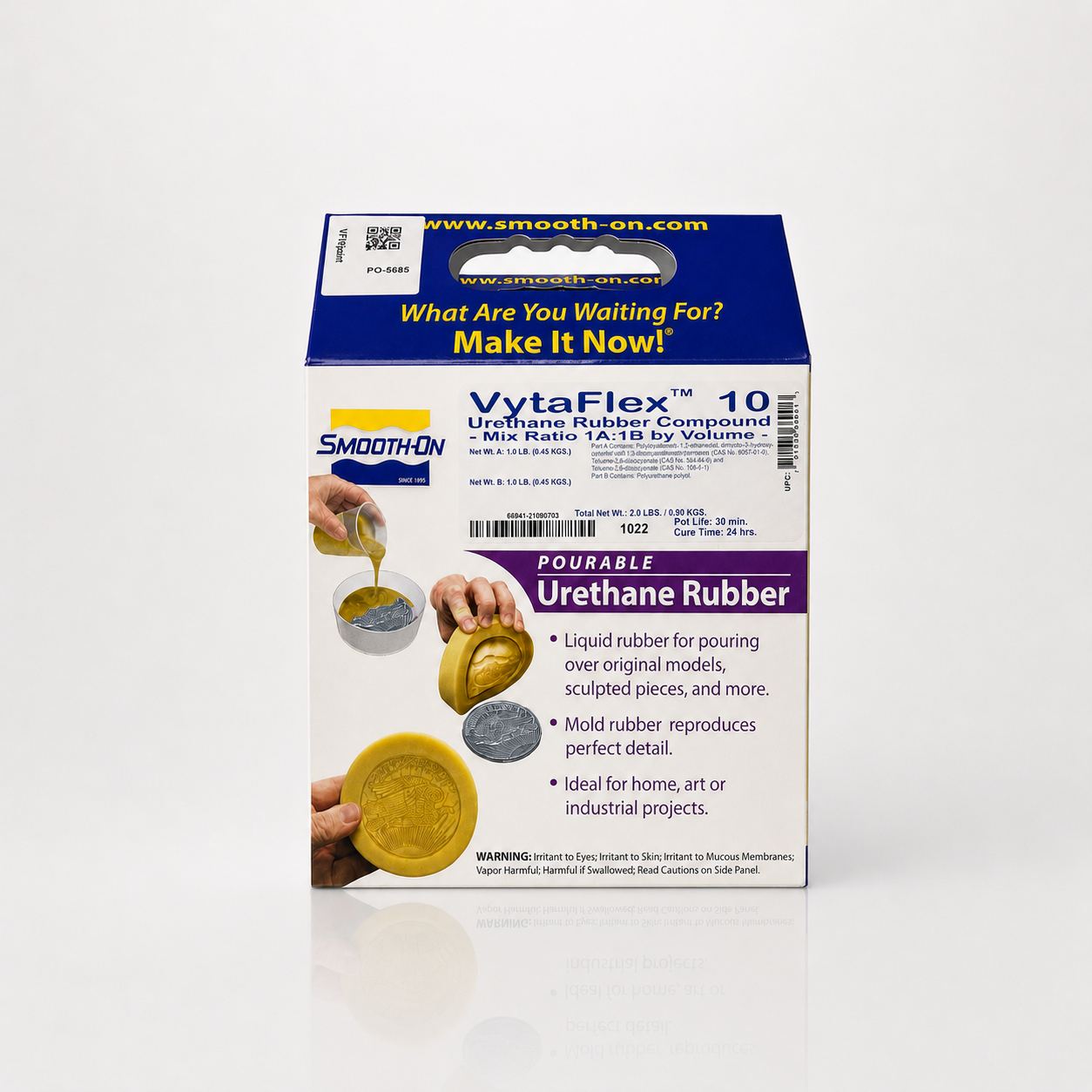
High-Strength Flexible Polyurethane Elastomer for Molding – Shore 10A to 60A | VytaFlex™

High-strength flexible polyurethane elastomer for molding and flexible parts.

From 10A to 60A Shore to precisely adjust flexibility, strength and performance.

From :  31,13 TVA Incl.
SKU N/A Categories ,

Description

The VytaFlex range includes high-performance casting polyurethane elastomers, available in Shore 10A to 60A hardnesses, for making molds and durable flexible parts. Their excellent abrasion, tear and wear resistance allows you to create both very soft elements and more durable firm technical parts.

Easy to cast and designed to offer excellent detail reproduction, VytaFlex is particularly suitable for molding concrete, plaster and mineral materials, as well as for making technical parts, protections, cushioning elements and elastic components. The wide choice of hardnesses allows you to precisely adapt the flexibility, strength and mechanical behavior to each application.

Applications

  • Flexible molds and production molds
  • Molding concrete, plaster and mineral materials
  • Reconstituted stone, slabs and decorative elements
  • Flexible and elastic technical parts
  • Stops, bumpers and cushioning elements
  • Wheels, rollers, rolls and anti-abrasion parts

Advantages

  • Simple 1:1 ratio by volume
  • Wide choice of hardnesses – Shore 10A to 60A
  • Excellent abrasion resistance
  • High tear resistance
  • Very low shrinkage
  • Excellent detail reproduction
  • Vacuum degassing not required

How to choose the right hardness?

  • Shore 10A → Very flexible: complex molds, deep undercuts, sculptures and fine details.
  • Shore 30A → Flexible and versatile: decorative objects, statues, pots, vases, candleholders, plaster and decorative concrete.
  • Shore 40A → Versatile and strong: ideal for most concrete molds, slabs, basins, planters, panels and architectural elements.
  • Shore 60A → Firm: large parts, heavy or simple molds, concrete furniture, edging, blocks and technical applications

Not sure about the hardness? Describe your application to us and we’ll guide you to the right rubber.

Implementation

  1. Prepare the mold or support, clean, dry and free of contaminants.
  2. Apply a release agent suited to the nature and porosity of the support.
  3. Measure components A and B precisely according to the recommended ratio.
  4. Mix thoroughly for 3 minutes, scraping the sides and bottom of the container.
  5. Pour slowly in a thin stream, from the lowest point, to minimize air bubbles.
  6. Allow to cure completely before demolding.

Technical specifications

VytaFlex™ 10
VytaFlex™ 30
VytaFlex™ 40
VytaFlex™ 60
Hardness (Shore A)
10
30
40
60
Ratio (A+B)
1:1
1:1
1:1
1:1
Working time (min)
30
30
30
60
Demold time (h)
24
16
16
16
Viscosity (mPa·s)
3100
1800
2000
2000
Density (g/cm³)
1,00
1,02
1,03
1,04
Tensile (MPa)
1,38
3,45
3,6
6,07
Elongation (%)
1000
1000
660
480
Tear (kN/m)
6,7
13,7
14,4
23,8
Shrinkage (%)
0.1
0.1
0.1
0.1
Colour
Off-white
Off-white
Off-white
Off-white

Safety

Work in a well-ventilated area.

Wear gloves and eye protection.

Avoid breathing vapors and aerosols.

Consult the SDS before use.

FAQ – Frequently asked questions

The lower the Shore A value, the softer and more flexible the elastomer. Higher hardnesses offer more firmness and are suitable for parts requiring greater mechanical strength.

Yes. The VytaFlex range is particularly suited to making durable molds for concrete, reconstituted stone, plaster and other mineral materials.

No, vacuum degassing is not required. However, it can be used if necessary. A slow pour in a thin stream generally allows you to effectively minimize air bubbles and achieve excellent results.

Yes. Polyurethane elastomers have strong adhesion to many materials. Using a suitable release agent is highly recommended, especially on porous surfaces, which should also be properly prepared and sealed before casting.

Yes. Polyurethane and silicone elastomers generally don’t adhere to each other, which allows you to cast VytaFlex™ directly into a silicone mold without a release agent. A particularly practical combination for making flexible parts, rollers, rolls, bumpers and technical components.

Polyurethanes are sensitive to moisture. Molds, supports, fillers and tools must be perfectly dry to avoid unwanted reactions and bubble formation.

Polyurethane generally offers excellent abrasion and wear resistance and is particularly suitable for production molds and technical parts. Silicone is often easier to demold and particularly suited to complex shapes and highly detailed reproductions. The choice mainly depends on the material being cast, the desired level of flexibility and the number of reproductions needed.

Related products

Related products

parasol (1)
Dear customers,
The Finres team will enjoy a long weekend from November 08 to 11.
Don’t panic, our website will remain open and your orders will go out on Wednesday November 12.
Orders placed before June 07 will be dispatched before our vacation.
Beautiful day!
Dear customers,
Our prices now include all taxes.
This is not an increase.
Taxes will no longer be added at checkout.